

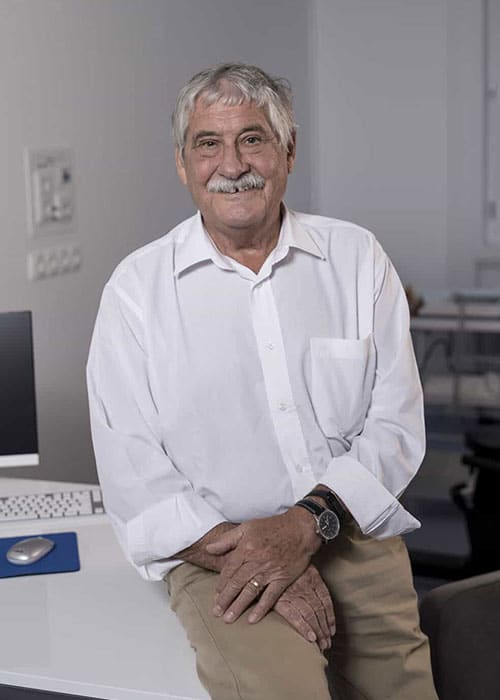
“A patient’s concerns must always be listened to fully and attentively!”
Dr. Attila Béla Balogh is a neurologist, psychiatrist, and clinical EEG specialist who leads the clinical neurophysiology and epileptology services at what was formerly St. Stephen’s Hospital and is now the South-Pest Central Hospital. He has been diagnosing, treating, and caring for patients with epilepsy for more than 46 years. Currently, more than 1,800 patients are under his ongoing supervision. He participates in the design and execution of international studies, most of which involve the clinical investigation of new antiepileptic medications. He also teaches and examines candidates preparing for their clinical specialist board examinations.
He spent the first twenty years of his career at the Psychiatric and then the Neurology Clinic of Semmelweis University, serving as a department head and research supervisor. He is a member of the leadership of numerous national and international medical organizations, and has an extensive list of international publications and conference presentations to his name. He researches, teaches, and above all, heals — because that is what he has dedicated his life to.
He grew up in a family of doctors and could not imagine any other vocation. When, as a third-year medical student, he finally had the chance to meet real patients, he felt the true magic of the profession for the first time, and said to himself: “God must love me, to let me be a doctor.” He firmly believes that a patient must always be listened to fully — because what they say often reveals far more than any diagnostic test. Understanding the history, the circumstances, and the acute problem requires genuine personal conversation — something no machine can replicate, and without which an accurate diagnosis and treatment plan become far more difficult to reach. This is especially true for episodes of unclear origin — whether they involve loss of consciousness, movement disorders, or unexplained pain. Everything has a cause, and that cause must be found. And for that, both parties are needed: doctor and patient.