

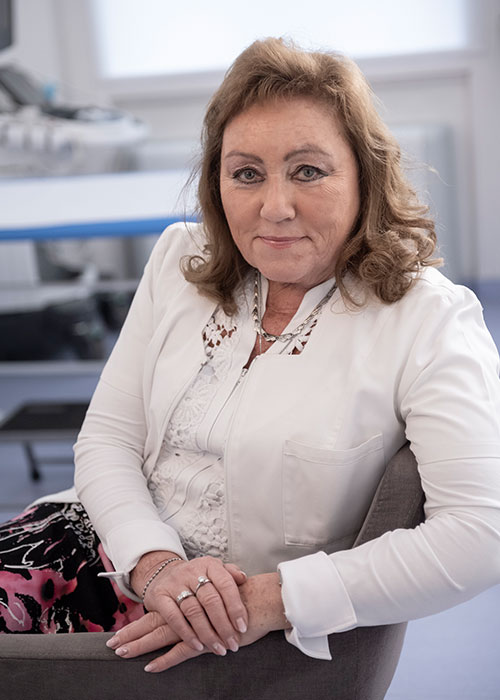
“Heart and soul — without these, there is no good doctor!”
I knew as early as secondary school that I wanted to be a doctor — and nothing else. At first, I didn’t even dare imagine it could happen, but I gave everything I had. I prepared with humility, patience, and tremendous dedication, just as I went on to complete my university studies. I desperately wanted to become a doctor first, and then a truly good one. Competition for places was fierce at the time, but I was accepted on my first attempt. When I graduated with distinction, finding a job in Budapest seemed hopeless, so I began my vocation in Fejér County. After a brief detour, I was able to return to the capital, where I started working in internal medicine and found my true place. I went on to pass my board examinations in both gastroenterology and diabetology.
I am loyal by nature — despite being invited abroad and to other fields, I have had just two workplaces in my 43 years of professional life. It has been a demanding road, but entirely worth it. What truly drew me in was operative endoscopy — perhaps because I played the piano for many years, and this field demands genuinely refined manual dexterity, and is enormously exciting. In diabetology, what I love is the ability to accompany my patients over a long period, managing complications over decades. In recent years this has become my primary focus, and internal medicine and gastroenterology are indispensable parts of it. Here, achieving and maintaining good metabolic control is critically important — to prevent complications or slow their progression. This is the key to treating those living with long-term chronic illness. The decades of experience and professional expertise I have accumulated across these three fields help me fulfil this mission.
This kind of long-term, shared work requires an extraordinary relationship of trust — which, I believe, is the very foundation of the healing process. When a patient walks through my door, I inevitably form an immediate professional “impression,” but what matters is getting to know them: their personal background, the whole person — because every treatment is tailored and individual. To achieve this, trust must be earned: by being present for patients with conviction, soul, and care. A doctor must be able to put themselves in their patient’s shoes, to truly understand what their symptoms mean to them. Half the healing is in understanding my patient — without that, even the greatest medical expertise falls short.
This is especially true for my patients living with obesity. My empathetic approach enables me to understand the real underlying causes of obesity and the difficulties that may stand in the way of weight loss. I consider it important to emphasise that obesity is not merely an aesthetic concern: it is the result of a complex interaction of genetic, hormonal, environmental and lifestyle-related factors. It must be stated clearly that obesity is a disease which can be effectively treated with appropriate professional support, modern therapy and personalised lifestyle guidance. My aim is for my patients not only to lose excess weight, but also to achieve a healthier life and a better quality of life in the long term.